
California’s affordability rate remained at a 16-year low during the fourth quarter, as higher mortgage rates and near-record-high home prices block many home shoppers from achieving the American Dream.
Fewer than one of every six (15%) households could afford to buy the median-priced home in California, the same percentage as the third quarter – and down slightly from 17% in fourth-quarter 2022, according to the California Association of Realtors.
Those families able to buy needed to earn at least $223,000 annually to qualify for a mortgage with a 20% down payment (about $167,000). Their monthly mortgage payment would be about $5,600.
CENTRAL COAST CRUNCH
The Central Coast’s Monterey and San Luis Obispo counties were the least affordable, with fewer than one of every 12 (8%) households able to purchase. The Far North, from Chico to Yreka, was the most affordable region, including a state-leading 49% in Lassen County.
In a hard-to-believe twist, the Bay Area – where many households enjoy hefty paychecks but endure lofty prices – was more affordable than Southern California. One in every five (20%) of households could afford to buy in San Francisco, compared to 11% (about one in 10) of those in Los Angeles, Orange and San Diego counties.
The national affordability rate was near a record-low 35% during the final quarter of the year, but much better than the figure in California.
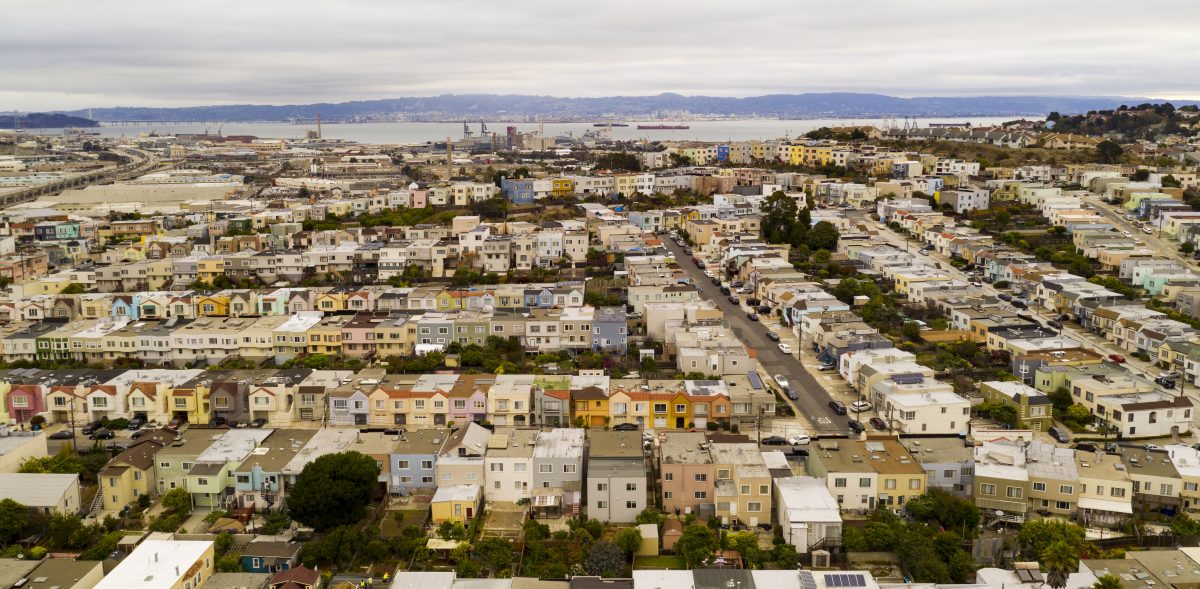
Feature photo of South San Francisco. ADOBE STOCK
Affordability rate by county for Q4 2023
| City/County | Q3 affordability rate | Household income needed | Monthly mortgage payment |
|---|---|---|---|
| California | 15% | $222,800 | $5,570 |
| Bakersfield | 28% | $101,600 | $2,540 |
| Fresno | 28% | $108,400 | $2,710 |
| Los Angeles | 11% | $236,400 | $5,910 |
| Orange | 11% | $347,600 | $8,690 |
| Redding | 36% | $98,000 | $2,450 |
| Riverside | 19% | $165,600 | $4,140 |
| Sacramento | 23% | $143,200 | $3,580 |
| San Diego | 11% | $249,200 | $6,230 |
| San Francisco | 20% | $418,400 | $10,460 |
| San Jose | 18% | $468,000 | $11,700 |
| San Luis Obispo | 8% | $242,800 | $6,070 |
| Stockton | 22% | $146,000 | $3,650 |
Source: California Association of Realtors

Can’t find an affordable house? Blame investors
Investors bought more than one of every four affordable homes in the nation during the fourth quarter, another challenge for first-time homebuyers already dealing with the highest mortgage rates in 15 years and near-record prices.
Investors completed deals for 26% of affordable homes – defined as the bottom third in price – compared to 24% a year ago, according to Redfin.
Despite what many may think, investors are people, too. They also prefer affordable homes because of 7%-range mortgage rates and high prices, and investors can enjoy hefty returns with still-solid rents.
‘MAY SEE MORE INVESTORS WADE INTO THE HOUSING MARKET’ WITH LOWER RATES
Seven of eight cities in California in the Redfin survey had an increase of investors grabbing affordable homes during the fourth quarter compared to a year ago, including 20%-plus rates in Anaheim, Los Angeles, Riverside, Sacramento, San Diego and San Francisco (see table below).
But “affordable” is a confusing word in California, where the median home price is near $800,000.
The average price for a home, regardless of price, bought by investors in California topped $1 million during the October-December period.
But the boom of investors buying homes, which started four years ago, could be easing and is “unlikely to shoot up like they did during the pandemic anytime soon,” says Redfin senior economist Sheharyar Bokhari. “That’s because borrowing costs and home prices remain high, the number of homes available to buy remains low … If the Fed cuts interest rates later this year as expected, we may see more investors wade into the housing market.”
Then, the battle will continue between consumers and investors.
Percentage of homes bought by investors and the median purchase price
| City | % of homes bought by investors | Median purchase price by investors |
|---|---|---|
| Anaheim | 25.5% | $1.23 million |
| Los Angeles | 21.5% | $1 million |
| Oakland | 16% | $1 million |
| Riverside | 21.5% | $541,000 |
| Sacramento | 21.5% | $554,000 |
| San Diego | 25.1% | $915,000 |
| San Francisco | 21.8% | $1.8 million |
| San Jose | 17% | $1.6 million |
Source: Redfin

Real estate agents are people, too. And with fewer listings and deals, more are leaving the profession. ADOBE STOCK
Fewer homes listed, fewer real estate agents
Remember when you were jealous of real estate brokers and agents who benefited from bidding wars, fast-rising prices and even faster-selling homes?
Guess what? Many are envying your 9-to-6 gig and that steady paycheck.
More than 38,700 members left the National Association of Realtors between December and January – and 62,000 members since October, a 4% drop during the past few months. NAR posted its largest annual decline last year since 2012.
California had the largest annual decline with 8,000 members, or about 4%, deciding to leave the profession, at least temporarily.
WILL THE AGENTS COME BACK?
NAR chief economist Lawrence Yun says the association often loses members in the fall and many return in the spring as the home-buying season, like the weather, warms up.
While home sales increased in January from a year ago, they are far from the breakneck pace of summer 2020 through spring 2022, when the Federal Reserve started to increase interest rates amid concerns of runaway inflation.
Yun adds that the current decline in membership is far from the exit experienced during the Great Recession. When the housing market collapsed 15 years ago, about 400,000 agents left the profession – almost five times more than the 85,000 since fall 2022.
The current decline in membership is fewer, at least so far, than Yun expected, especially with home sales at the lowest level since 1995.
“Further membership decline should be anticipated, given the reduction in business opportunities over the past year,” he says. “Most state and local associations should anticipate further declines in memberships over the next 24 months based on the lag effects of past housing cycles.”
NAR also anticipated a 15% decline in membership after increasing fees in May. And, of course, the recent changes and drama at the NAR, including a $1.8 billion verdict, are likely another reason for the slide in membership.
California agents can help clients buy and sell homes without being a member of CAR or NAR.

Negotiating the commission can save sellers quite a bit of money. ADOBE STOCK
Hefty prices, low commission rates
California is one of the priciest housing markets in the nation but cash-strapped buyers save in one area – real estate commissions.
The Golden State, where the median home price often tops $800,000, has the second-lowest commission rate in the nation, according to Home Bay.
The average broker in California earns a 4.92% commission, just behind New Hampshire at 4.83%.
The figure is below the national average commission rate of 5.5% – and below the highest rate of 6% in North Dakota and Vermont.
COMMISSIONS CAN CUT MANY WAYS
So, the average commission rate on a home sold is about $39,500 in California.
Now, if the buyer and home seller have their respective agents, the commission is split and greatly reduces the payday. Plus, the brokerage company and agents also divvy up dollars, meaning the almost $40,000 commission could be cut into four slices.
Commissions earned cover numerous costs – such as advertising, listing fees and membership dues – in addition to pay for agents.
Commission rates are negotiable between homeowners and listing agents.

The California Dream often comes with a small yard. SHUTTERSTOCK
Few California homeowners live large in the yard
California has some of the smallest yards in the nation, largely because of the high cost of land.
Almost a third of the cities with the smallest yards are in California, including the postage stamp space for homeowners in San Francisco. The city, known for its pint-sized houses, has the third-smallest lots in the nation, behind first-place Hoboken and Union City in New Jersey.
LARGEST LOTS IN FALLBROOK
The average San Francisco yard is one-third the size of the average house in California, according to a new report from LawnStarter. The company crunched data to determine the largest — and smallest — yards in the 2,000 most populated cities in the U.S.
Fallbrook in northern San Diego County had the largest yards in California and the fifth-largest in the U.S. Apple Valley in San Bernardino County was the only other city in the state to land in the top 100 largest yards in the U.S.
Seven cities in California were among the top 200, but the state had 29 of the 100 smallest yards, according to LawnStarter.
Carney, Md., has the largest yards at 1.14 acres, followed by Linton Hall, Va., and Mequon, Wis. Carney and Linton were the only two cities where the average yard topped an acre.
California cities with the largest yards
| Largest yards | Acres |
|---|---|
| 5. Fallbrook | 0.85 |
| 93. Apple Valley | 0.55 |
| 120. Atascadero | 0.53 |
| 125. Norco | 0.52 |
| 154. Hesperia | 0.50 |
| 157. Madera | 0.49 |
| 198. Los Gatos | 0.47 |
| 256. Lafayette | 0.43 |
| 263. Poway | 0.43 |
| 281. Escondido | 0.42 |
Source: LawnStarter


